
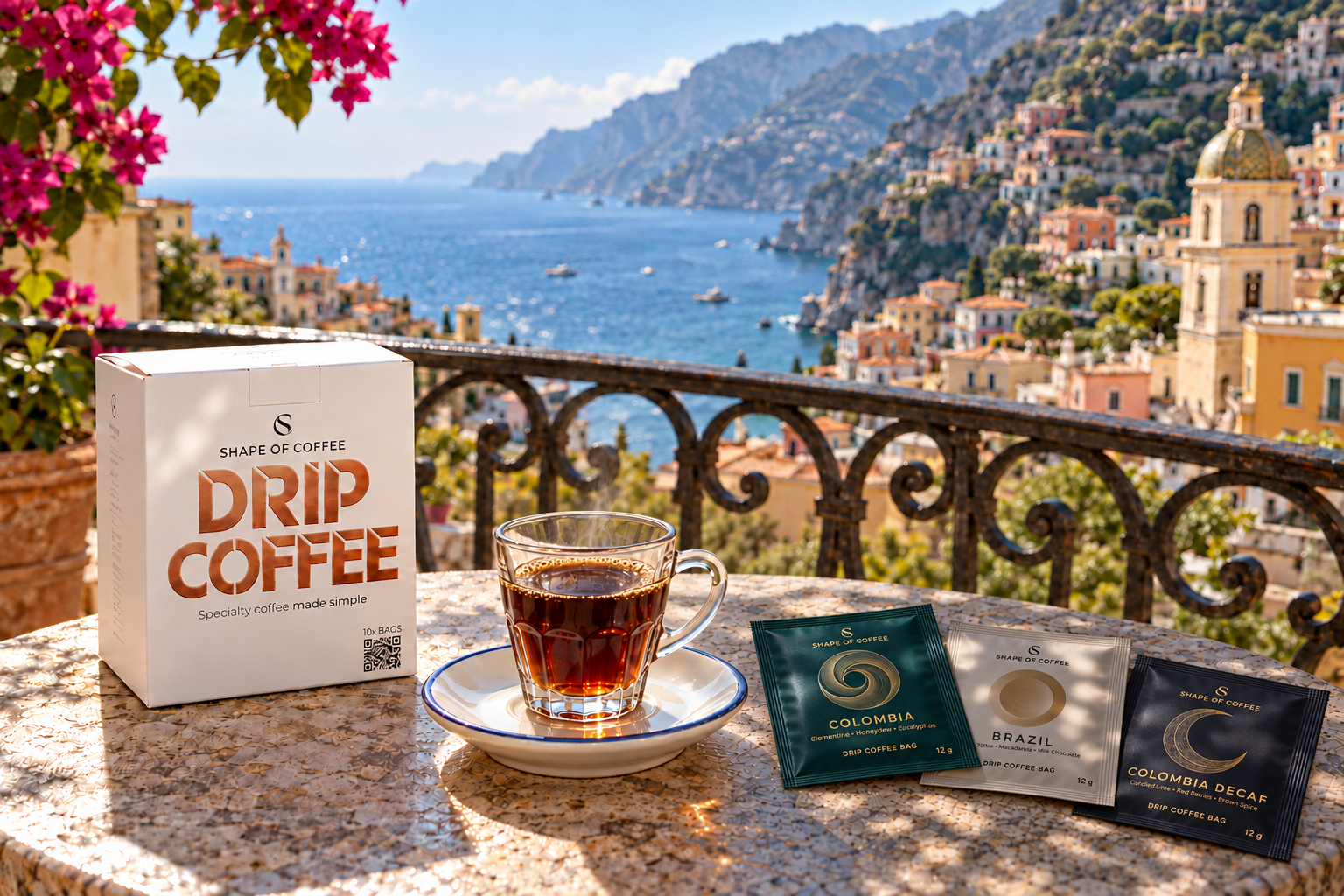
A familiar coffee routine, wherever you wake up
From hotel rooms to weekends away, take your coffee routine with you. Discover speciality drip bags for flavourful filter coffee wherever you wake up.
You wake up in a room that is not yours. For a moment, you have to remember where the light switch is. Your clothes are still in the suitcase, and the plan for breakfast is somewhere in a message thread.
Then you spot the kettle.
When you are away from home, small familiar things can make the morning feel easier. Your own coffee is one of them. Packing a few Shape of Coffee drip bags gives you something you have already chosen, ready for a quiet cup before you head out.
The format combines ground speciality coffee with a filter that hangs over your mug. With hot water available, you can brew a quality filter coffee wherever you are. How drip coffee bags work.
A coffee bag with places to be
Imagine the life of a regular bag of coffee. He lives in the kitchen cupboard, the door shut most of the day. He hears the keys, the suitcase wheels, the plans for a weekend away. Where is everyone going? He never gets to see.
A drip coffee bag has a different diary. He slips into a travel bag and wakes up in a hotel, comes along on holiday and makes an appearance at the beach house. By tomorrow, he could be beside a mug on a balcony somewhere new. Small enough to come along, looking good beside your cup, with speciality coffee inside: this bag has places to be.
Pack for the mornings you expect
Start with a simple question: where will you make your coffee?
A hotel room may have a kettle and a mug. A holiday rental might have a kitchen you can use. If you are camping, you will need to bring your own way to heat water. Checking before you leave helps you pack for the place you are actually visiting.
Take enough drip coffee bags for the cups you expect to make. Keep them unopened until you need them and somewhere easy to reach in the morning.
Whether you are using a hotel mug or your own camping cup, unfold the handles and hang the filter securely over the rim. You are ready to pour.
Make a cup before making plans
There is a pleasure in having one part of a travel morning already decided.
Find a steady place to put your mug. Open the coffee bag, secure the handles and pour slowly, following the instructions supplied with the coffee. Let it drain and remove the filter before drinking. Shape of Coffee’s preparation guidance.
Now you can look at the map, check the weather or decide where to go for breakfast with a cup beside you.
As the water passes through the grounds, you are brewing the speciality coffee you chose to bring. A chocolate-like note, a fruity aroma or a delicate floral character can be part of the morning, depending on your choice. There is flavour to discover before you even leave the room.
The same idea works outdoors
At a campsite, the setting changes the experience. There might be damp grass outside the tent, a jacket thrown over your shoulders and somebody still asleep while you heat the water.
Keep the brewing setup steady and give yourself enough space to pour. Once you have finished, collect the used filter, grounds and wrapper so you can take them away with your other rubbish.
You do not need to make the scene elaborate. A mug, a place to sit and coffee you enjoy can be enough for that first morning pause.
Take a flavour you want to wake up to
For your first trip with drip bags, choosing a familiar coffee can help. Brew it at home once or twice so you know how the preparation feels and what you enjoy in the cup.
Or make the trip a chance to explore a different flavour profile. Read the current range, choose something that appeals to you and pack it alongside your usual travel essentials.
The next morning might begin in a guest room, a holiday kitchen or outside a tent. Explore our speciality drip coffee flavours and choose the cup you want to take with you.
Keep reading: Good coffee, even when your morning is full — for taking the same simple routine into everyday life.
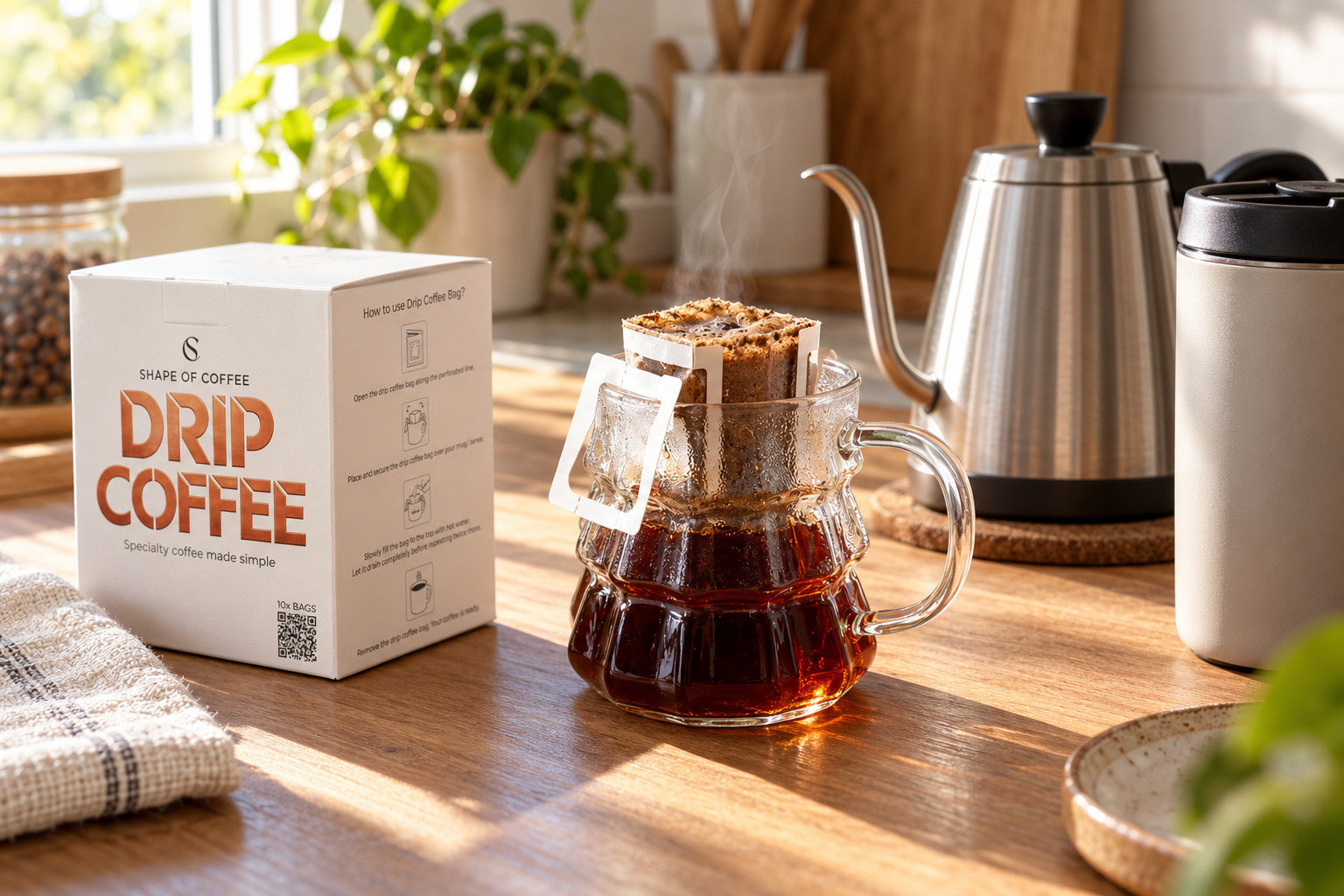
Good coffee, even when your morning is full
A full morning can still include a flavourful filter coffee. Discover how our speciality drip bags fit breakfast, the commute and your first cup at work.
The kettle is on. Your phone is charging somewhere you cannot quite remember. There is a bag to pack, a message to answer and a weather forecast suggesting you should probably find an umbrella.
Some mornings, your drip coffee happens in the middle of everything else.
You still want a cup you enjoy. Shape of Coffee’s speciality drip coffee bags make the routine simple: open the bag containing ground coffee, hang the filter over your mug and pour hot water through it.
You do not need a separate grinder or dripper. The format brings you a freshly brewed morning filter coffee, full of flavour and easy to make. How the format works.
Give your coffee a place in the morning
You can make drip coffee as soon as the kettle is ready. Take a bag, open it and hang the filter over your mug. There is no coffee to weigh or separate paper filter to fit into a brewer.
Hot water passes through the ground speciality coffee and into your cup. That little filter is doing the work of a pour-over, giving you room to enjoy the coffee’s aroma and character while keeping the routine straightforward.
Pour slowly, following the instructions on your pack. Let the filter drain, then remove it. Your drip coffee is ready for the first sip. Our brewing instructions.
You might notice a fruity aroma first, or a sweetness that becomes clearer as the cup cools. A simple morning brew can still give you something worth slowing down for.
A cup for the journey ahead
If your morning ends with a walk to the station or a drive to work, brew your drip coffee before you leave and transfer it into your travel cup. Check the lid, gather your things and take it with you.
That changes where you enjoy the coffee without making the brewing part more complicated. Your first sip might happen at the kitchen table. The next might be outside, waiting for the bus, with your coat finally zipped up.
On days when you would rather brew after arriving, take a drip coffee bag with you. A kettle, a mug and somewhere to pour are the essentials. Your morning filter coffee can happen at the office just as easily as at home.
Make room for the flavour you like
An easy brew matters. So does the coffee inside the bag. We bring speciality coffee into a drip format so that a busy morning can still include a cup with sweetness, aroma and a flavour you want to return to.
Think about the cup you usually look forward to. Perhaps you like a rounded, chocolate-like character. Perhaps you prefer something with a brighter fruit note. Start with that preference when exploring the range, rather than choosing a coffee because its description sounds impressive.
Our Brazil speciality coffee has milk chocolate and macadamia among its tasting notes. If you enjoy that kind of profile, it is a good place to start. Those notes describe the coffee’s character, rather than added flavourings. Explore our coffees.
You can keep the morning familiar and still try a different coffee. The preparation stays recognisable; the cup gives you something new to notice.
Start with one ordinary morning
You do not need to redesign your breakfast or become someone who gets up an hour earlier. Open a drip coffee bag when you want a cup and see how it fits.
Maybe you drink it while making toast. Maybe you take it on the walk to work. Maybe you sit down for the first few sips before the messages begin.
There is room for speciality drip coffee in a full morning. The brewing is easy; the flavour gives you a reason to enjoy it.
Your workday deserves a coffee break you enjoy.
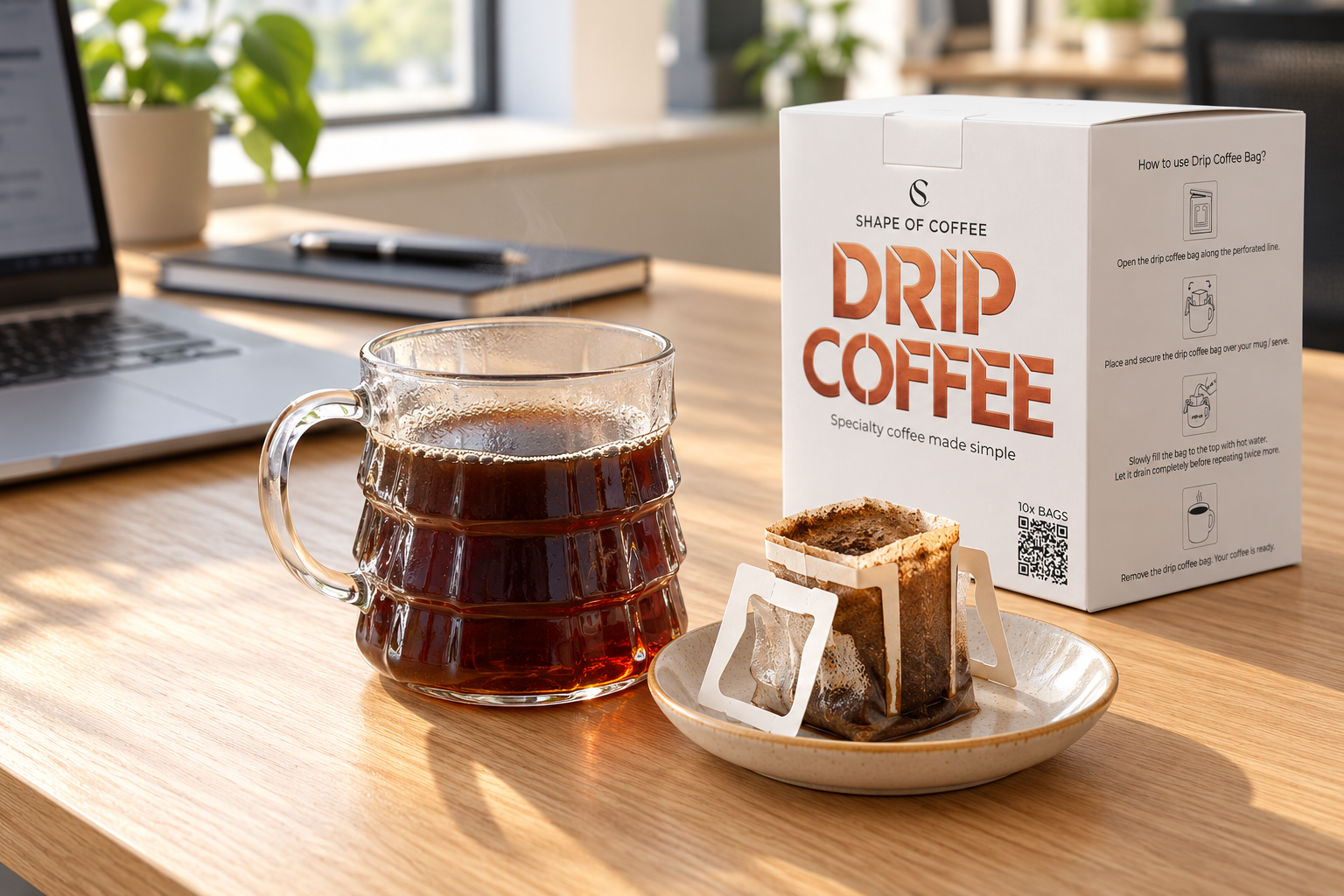
Your workday deserves a coffee break you enjoy
Make your workday break a cup worth enjoying. Our speciality drip bags bring freshly brewed filter coffee and layers of flavour to your office mug.
There is a particular kind of coffee break that barely feels like a break. You make a drink while checking a message, carry it back to your desk and remember it half an hour later, somewhere behind the laptop.
The coffee was there. The pause went missing.
An enjoyable workday cup does not have to involve leaving the building or setting up a collection of brewing equipment. Sometimes it starts with choosing your own coffee and giving yourself a few moments to make it.
Shape of Coffee’s drip bags bring speciality ground coffee into a format you can keep alongside your workday essentials. Each serving has its own hanging filter, so you can brew into a suitable mug without a coffee machine. About Shape of Coffee’s drip bags.
A small setup that is yours
You might already have a favourite office mug. Add a few unopened drip coffee bags and you have the beginnings of a routine.
Keep them somewhere practical: in a cupboard near the kettle, or with the things you bring to work. The point is to make your next coffee easy to remember and easy to find.
Before the first brew, check that the filter handles fit securely over your mug. Having a cup that works with the bag makes the process more comfortable to repeat. Choose a clear spot near the kettle where you can pour without juggling a phone, a notebook and somebody else’s lunch container.
Let the brewing become the break
Open the bag, set the filter over your cup and pour hot water slowly through the coffee. Follow the pack instructions, allow it to drain and remove the filter when you have finished. Read the preparation steps.
Water flows through the ground speciality coffee, drawing flavour into the cup as it drains. It is a small pour-over: you get to enjoy freshly brewed filter coffee, with the coffee and filter already portioned together in the bag.
Once it is ready, try drinking the first few sips away from your desk. Stand by a window, sit in the kitchen or take the cup outside if there is somewhere nearby. You might only have a brief gap between calls. It can still feel like a gap.
Choose coffee for your taste
Office coffee is often a shared decision. Your own drip bags let you choose the cup you are curious about, whether you work in a large office, a shared studio or a spare bedroom.
The easy preparation is only part of the appeal. The cup can have several layers to explore: fruit in the aroma, sweetness in a sip, a chocolate-like finish or a delicate floral character, depending on the coffee you choose. Read the flavour descriptions and start with a profile that sounds appealing.
Our Colombia speciality coffee lists clementine and honeydew among its tasting notes. There is also a Colombia decaf in the range. Check the descriptions to find the coffee that interests you. See our coffee range.
You can try something different without changing your whole setup. That makes discovery feel manageable, even during a busy week.
Keep the routine flexible
Some days you will have time to sit and finish the cup. On others, a meeting will start early or a colleague will stop you for a conversation. There is no perfect version of a coffee break to maintain.
The useful part is having an option you can come back to. Keep your mug clean, replenish the bags when you are running low and leave yourself a place to brew.
Tomorrow’s calendar may be crowded. You can still choose the coffee you want to drink when you find a moment.
Keep reading: Good coffee, even when your morning is full — for a routine that starts before you leave home.
Drip Coffee Bags vs Brew Bags: Which Format Fits Your Coffee?
If you've spent any time exploring the UK's booming single-serve coffee market, you've probably noticed two formats popping up everywhere: drip coffee bags and coffee brew bags. They look similar at a glance — both promise a fuss-free, mess-free cup of coffee without a machine in sight — but they're built differently, brew differently, and suit different brands for different reasons.
At Shape of Coffee, we manufacture both formats and handle the coffee bag packaging behind them, so we get asked this question constantly by roasters, cafés, and coffee brands across the UK: drip bag or brew bag — which one is right for me?
Let's break it down properly.
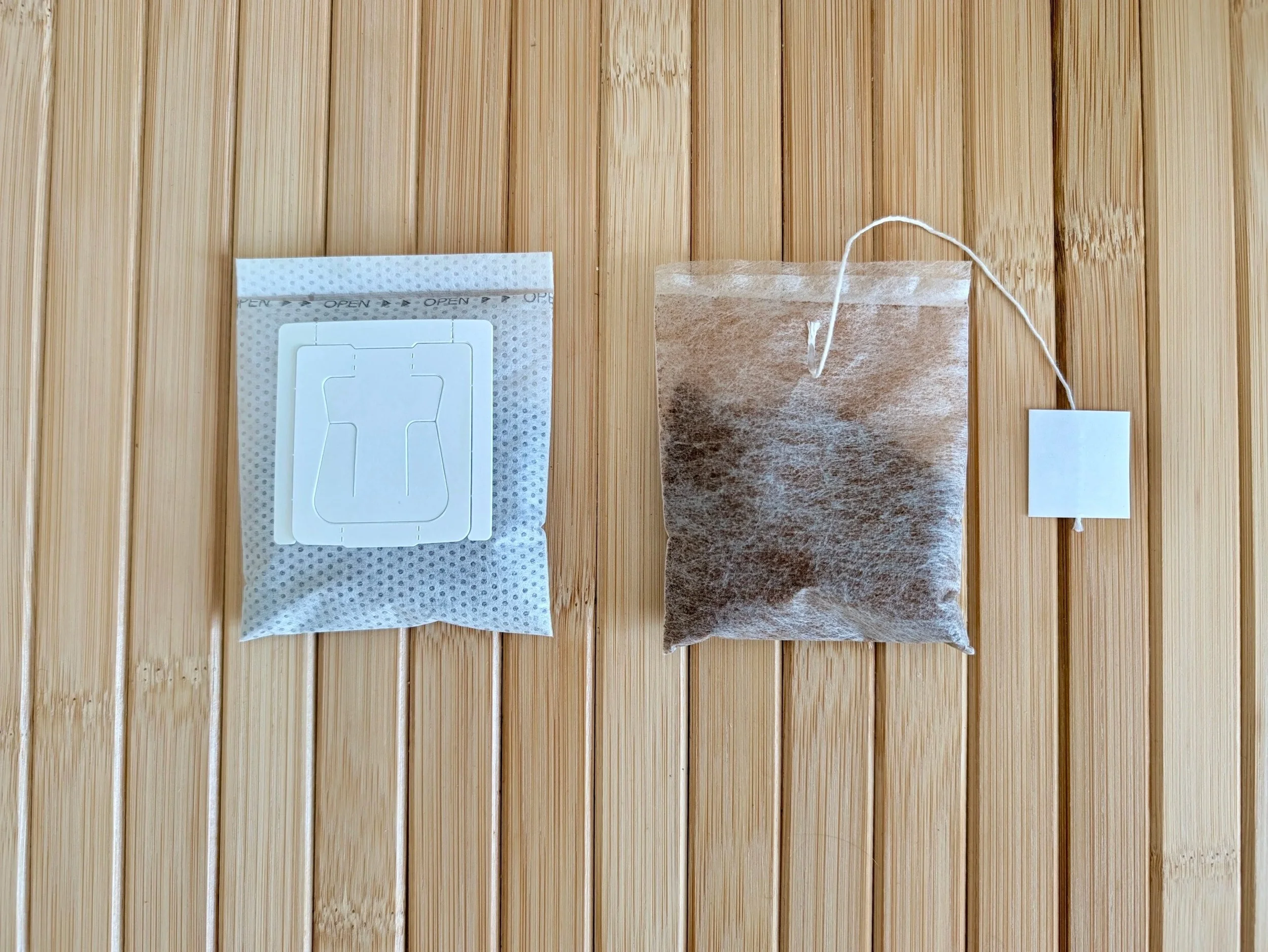
Drip and brew bag photo
What Is a Drip Coffee Bag?
A drip coffee bag is a small, individually portioned sachet of ground coffee with fold-out arms or "wings" that hook onto the rim of a mug. You tear it open, hang it over your cup, and pour hot water directly through the grounds. No filter, no cafetière, no kettle-side faff — just a genuinely excellent cup of coffee in under three minutes.
Drip coffee bags UK sales have climbed steadily over the past few years, largely because they solve a very modern problem: people want specialty-grade coffee, but they don't always have the time, equipment, or inclination to grind, weigh, and pour. A drip bag delivers that experience in a format that fits in a coat pocket, a desk drawer, or a hotel room tray.
Best suited for:
Specialty roasters wanting to showcase single-origin coffees in a portable, giftable format
Office and hospitality use, where consistency and speed matter
Travel, camping, and "coffee on the go" ranges
Subscription boxes and sampler sets
What Is a Coffee Brew Bag?
Coffee brew bags (sometimes called immersion bags or steeping bags) work more like a tea bag than a pour-over filter. Instead of pouring water through the grounds, you submerge the bag directly into a mug, cafetière, or jug of hot water and let it steep for a few minutes before removing it.
Because the coffee is immersed rather than filtered through, brew bags tend to produce a fuller-bodied, more robust cup — closer to a cafetière than a pour-over. They're also brilliant for batch brewing, since one bag can steep in a larger vessel to make multiple servings at once.
Best suited for:
Brands wanting a bolder, full-immersion flavour profile
Batch or jug brewing for offices, events, and catering
Simpler, more forgiving brewing for less coffee-literate customers
Cost-effective large-format packs
Drip Bags vs Brew Bags: The Key Differences
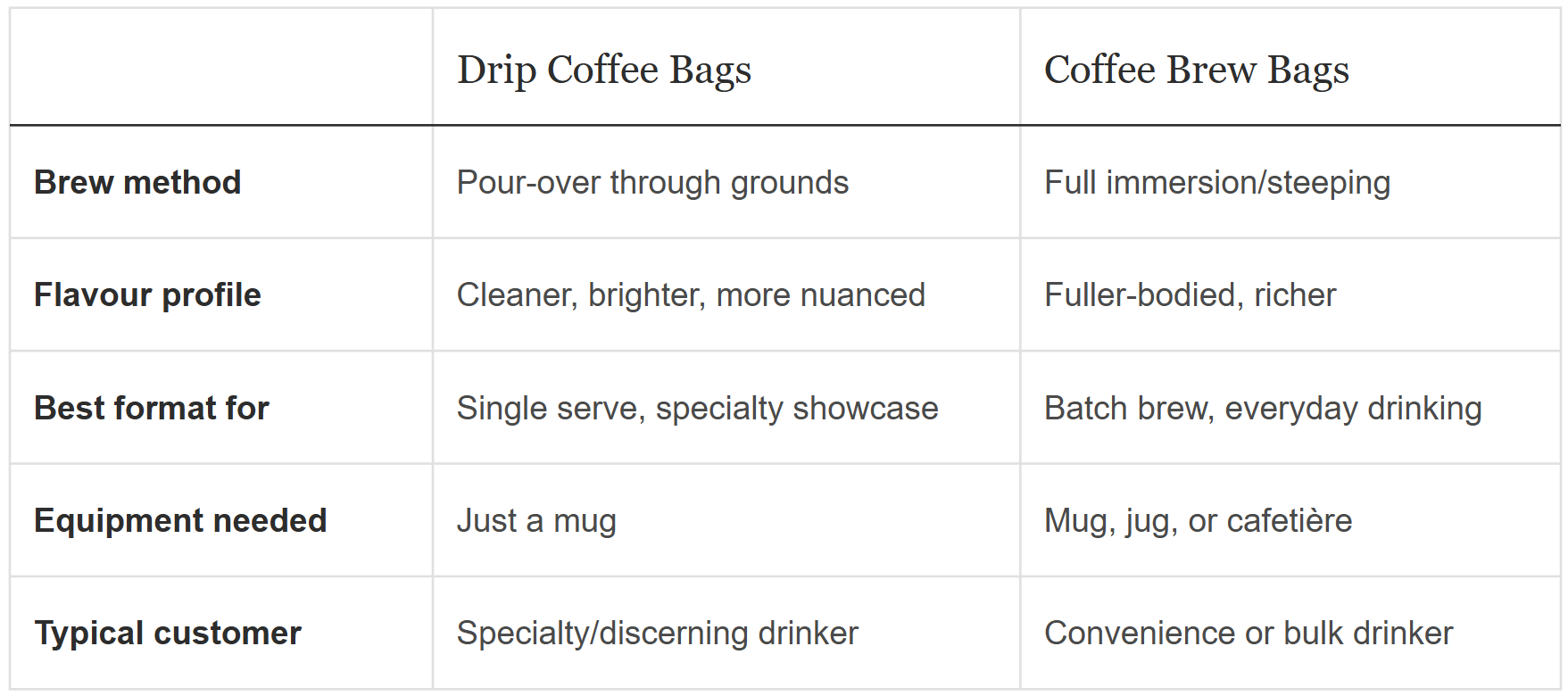
Drip bags vs brew bags comparison chart
Why Packaging Makes or Breaks Both Formats
Here's the part many new coffee brands underestimate: the format is only half the equation. Coffee bag packaging in the UK has to work just as hard as what's inside it.
Ground coffee is highly reactive to oxygen, light, and moisture. A beautifully roasted, perfectly ground batch of coffee can taste stale and flat within weeks if it's sealed in the wrong material. That's why the packaging around your drip bags or brew bags needs to:
Preserve freshness with proper barrier film that blocks oxygen and moisture ingress
Protect aroma and flavour during transit, storage, and shelf life
Look the part — because in a crowded UK coffee market, the outer packaging is often the first thing that sells the cup
Match your brand values, whether that's compostable and eco-conscious materials, minimalist design, or bold shelf-stopping colour
At Shape of Coffee, we design and produce coffee bag packaging UK brands can rely on for both drip and brew formats — from the individual sachet through to outer cartons and retail-ready boxes. Getting this right isn't an afterthought; it's what protects everything your roaster worked hard to achieve in the cup.
Which Format Should You Choose?
If you're still torn, ask yourself these questions:
Do you want to highlight a specific origin or roast profile? Go with drip bags. Their pour-over method gives more clarity and nuance, which is ideal for showing off a coffee's character.
Are you serving groups, offices, or events? Coffee brew bags UK buyers often choose this format specifically for batch brewing — one bag, one jug, multiple cups.
Is convenience the number one priority for your customer? Both formats deliver convenience, but drip bags edge ahead for true single-serve simplicity, while brew bags edge ahead for larger volumes with minimal effort.
Do you want to run both? Great idea — drip bags for their premium, single-origin specialty range, and brew bags for their everyday, higher-volume offering. It's a smart way to serve different customer occasions under one brand.
Bringing It All Together
Drip coffee bags and coffee brew bags aren't competitors so much as two different tools for two different jobs. One is built for precision and a clean, pour-over cup; the other for ease, body, and batch brewing. The right choice depends on your customer, your coffee, and the experience you want to deliver.
Whichever route you take, the format is only as good as the packaging that carries it. That's where Shape of Coffee comes in — we manufacture both drip coffee bags and coffee brew bags for UK brands, and we handle the coffee bag packaging design and production that keeps your coffee fresh from roastery to cup.
Ready to bring your coffee bag range to life? Get in touch with the Shape of Coffee team to talk through drip bags, brew bags, or a custom packaging solution built around your brand.
The Real History of the Drip Coffee Bag (It's Messier Than You'd Think)
If you Google "who invented the drip coffee bag," you'll get a tidy answer within about three seconds: a Japanese company in the early 1990s, job done. Case closed.
Except it isn't. The more we looked into it, the more it turned out that almost every "definitive" answer floating around online is repeating the same handful of unverified claims — and none of them quite line up with what's actually sitting in the patent archives.
So we went and read the patents ourselves. Here's the version of the story that the paperwork actually supports.
Long before Japan: the American false starts
The drip bag concept — a disposable filter that sits on top of a single cup and lets you brew one portion at a time — didn't spring into existence in the 1990s. People had been chasing the idea for decades.
As early as 1946, a Connecticut inventor filed a patent for a specially engineered paper designed to filter coffee, though the fibres were far too coarse by today's standards — closer to the mesh of an old-fashioned tea bag than anything you'd want steeping your morning cup.
By 1958, a Washington-based inventor had patented a small stand with two arms that gripped the sides of a cup, holding a filter bag in place — arguably the first real attempt at solving the "how do I brew exactly one cup, with no equipment, and then just bin it" problem. A separate 1958 patent out of New York proposed something stranger still: a small square filter basin that perched on the rim of a mug.
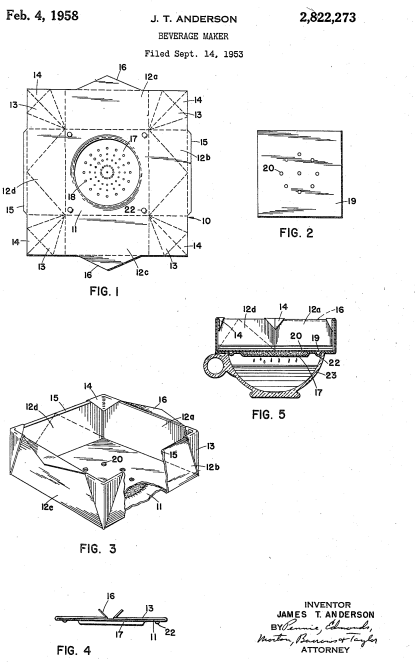
Source: United States Patent US2822273
None of these caught on commercially. But they planted the idea that would eventually cross the Pacific.
The 1970s: Europe and the US keep trying
A 1971 French patent got noticeably closer to the modern shape — a cylindrical device with an internal pouch of ground coffee, designed to brew a single serving directly into a cup. Five years later, a Californian inventor patented a funnel-shaped, fully disposable single-serve device, explicitly designed to be thrown away after one use. It looked good on paper. It also would have cost more to package than the coffee inside it was worth — a problem that dogged this category for years.
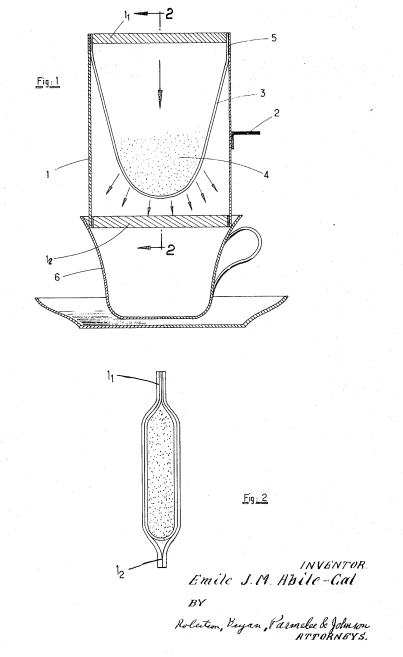
Source: United States Patent US3615708
Japan takes over — and starts filing patents in earnest
By the mid-1980s, the centre of gravity shifted decisively to Japan, where several inventors were racing to solve the two real engineering problems standing between "interesting idea" and "product you can actually manufacture at scale":
A filter material fine enough to hold back ground coffee, but flexible enough to survive packaging, shipping, and handling without tearing.
A way to hang it on a cup that didn't involve tea-bag-style string-and-tag arrangements that tipped over the second they got heavy with water.
A 1985 Tokyo patent proposed a fold-out holder that clipped onto a cup with a separate coffee pouch inside — a genuine missing link, and one that explicitly cited an earlier, distinctly odd 1958 American patent for a "square bath" that sat on a mug as its inspiration. That's a nice reminder that good ideas rarely arrive from nowhere; they get quietly borrowed and improved.
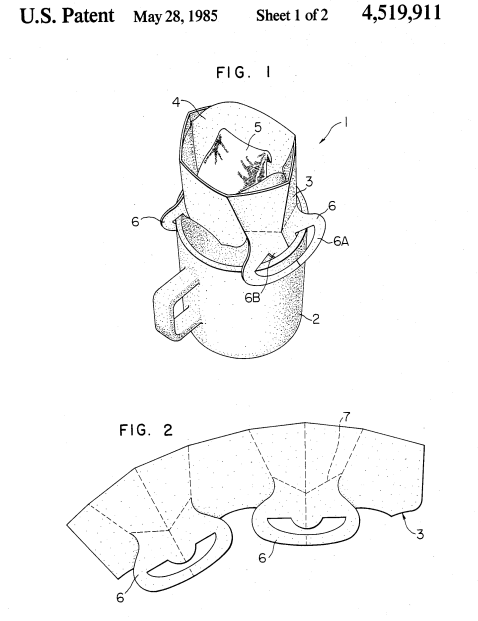
Source: United States Patent US4519911
From there, things moved quickly. A 1987 patent out of Chofu, Japan proposed a triangular, fully disposable single-serve pack, designed for people who wanted to enjoy fresh coffee on the go without carrying a flask of coffee that could go stale by lunchtime.
The material problem gets solved
The real breakthrough, though, was in the material. A 1989 Tokyo patent — filed by a team including an inventor named Kaichi Suzuki, working for a textile-turned-filter manufacturer called Yamanaka — described a new nonwoven fabric engineered specifically to solve the "too porous" (letting grounds through) versus "too dense" (over-extracting and slowing the brew) trade-off that paper and cloth filters had struggled with for decades.
Two years later, in 1991, the same company combined that new material with a cup-mounting design in a single patent — effectively the first modern drip bag, in both form and function. It wasn't perfect: early versions gripped the cup from one side only and had a habit of tipping into the coffee under the weight of the water, which can't have made for a great first impression.
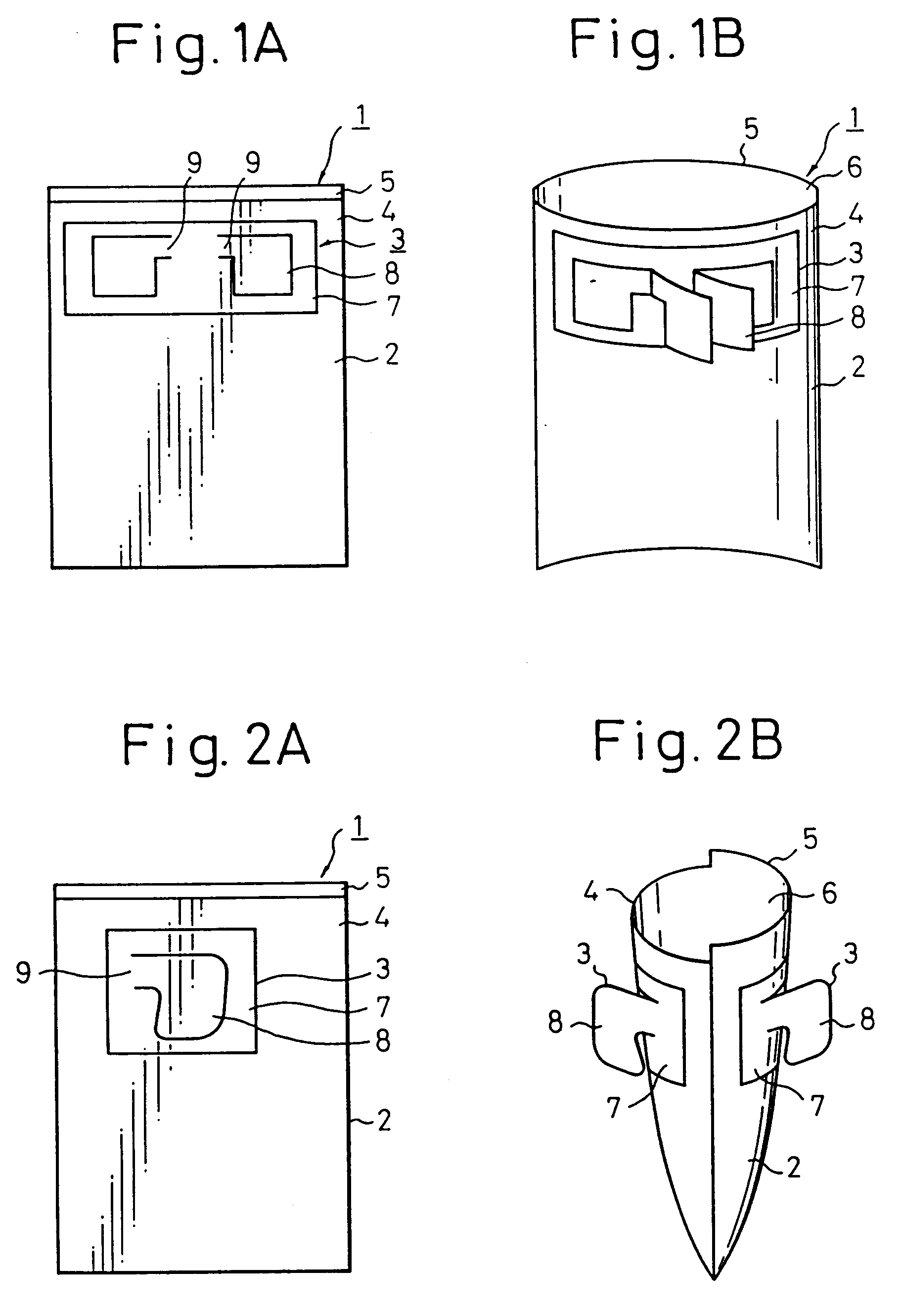
Source: EP0463181A1
Key Coffee makes it commercial
Here's where the story gets interesting. Yamanaka gets credited online more often than not as "the inventor of the drip bag" — but its own corporate history barely mentions it. The company that actually turned the drip bag into a real commercial product, and the one whose lineage is most recognisable in what you'll find on shelves today, was Key Coffee.
Key Coffee launched its first Drip Bag around 1990, and by 1997 had significantly reworked the design under the name Drip On — repositioning the two support "ears" so the bag balanced far more securely on the cup, closer to what most drip bags look like now. Interviews from the company at the time credit a product developer at Key Coffee (also named Suzuki, somewhat confusingly a different one) with refining the format so that home brewers no longer needed to bother with a pre-wetting step before pouring — you could just start pouring water straight away, which was the whole appeal.
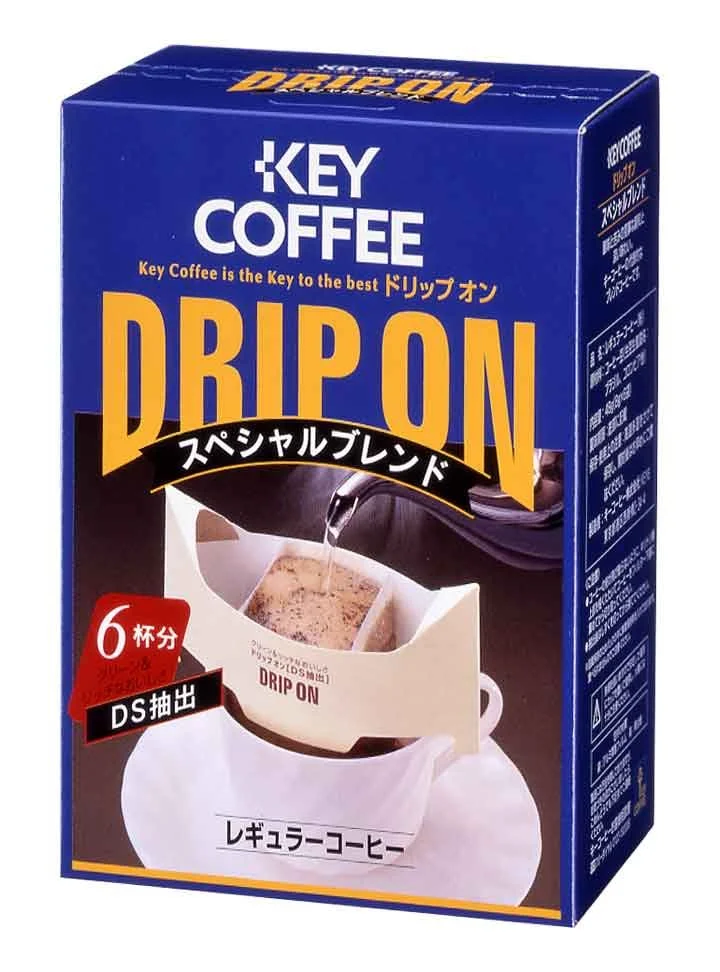
Source: Key Coffee website
Notably, one of Japan's largest coffee companies, UCC — a name that shows up constantly in "who invented drip bags" articles — appears to have no drip bag patents at all. Its own corporate timeline covers canned coffee, its Blue Mountain estate in Jamaica, and its Kona coffee farm in Hawaii in detail, but the drip bag simply isn't part of the story it tells about itself. It's a useful reminder that repeated claims online aren't the same as evidence.
The shape you'll recognise today
The format most people picture now — a rectangular bag with two folding "ears" that hook over opposite sides of a cup, and a tear strip along the top — traces most clearly to a 2004 patent filed by Ohki Co Ltd, a company that still produces filter materials for drip bags used across the industry today. That patent tightened up nearly everything that had come before it: a snugger fit on the cup, a filter material properly tuned for even extraction, and a design cheap enough to actually manufacture by the millions.
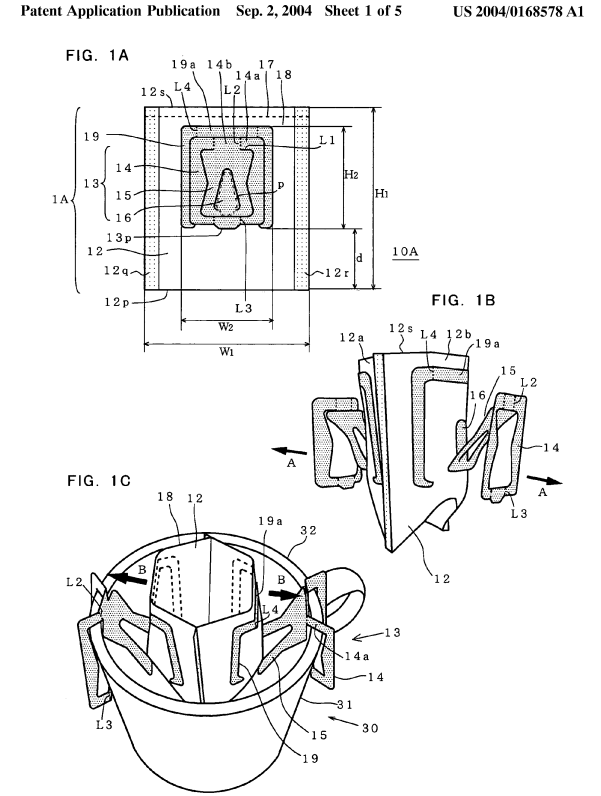
It took roughly fifteen years, half a dozen companies, and a small pile of overlapping patents to get from "interesting one-off idea" to "thing you can buy in a supermarket." Good design rarely arrives fully formed — it gets chipped away at, one flawed attempt at a time, until someone finally gets the shape right.
Why we're telling you all this
We make drip coffee bags because we think the format deserves better than instant coffee's reputation. It's easy to forget, when you're tearing open a bag over your mug in the office kitchen or on a train, that there's genuinely decades of quiet, unglamorous engineering behind that simple little pouch — people trying, failing, and trying again to solve a problem as small as "how do I get one really good cup of coffee, brewed properly, with nothing to wash up afterwards."
That's still the whole idea. We just start with proper UK-roasted, single-origin coffee instead of whatever the 1990s Japanese market had on hand — but the format itself owes a genuine debt to a chain of Japanese engineers who spent the best part of two decades getting the details right.
If you want to see where all that patent-office trial and error ends up, have a look at our range of drip coffee bags — same basic idea, considerably better coffee.